GloNetComp
Who We Are
PCT Applications
US Patents
In Depth

What’s New
Just Released our third PCT - WO 00.70448


8326 Second Avenue
Vienna, VA 22182-5147
Phone: 703-207-3051
Fax: 703-931-1116

THE P2P PROBLEM: SECURITY

Global Network Computers has developed an international portfolio of patent applications on distributed and "peer-to-peer" Internet computing systems like SETI@home, Napster, and Gnutella, including commercial and security aspects.

In particular, Global has focused on the biggest problem in peer-to-peer computing: security. Allowing unknown third parties direct access to a PC user's hard drive, as Napster does, for example, obviously presents a major threat to the PC user's personal and system files. Most Napster users wisely decline to share files from their hard drives because of the glaring security problem, but so many of these "freeloaders" opt out that the performance of Napster is degraded by their absence.

THE SOLUTION: AN INTERNAL FIREWALL HYBRID

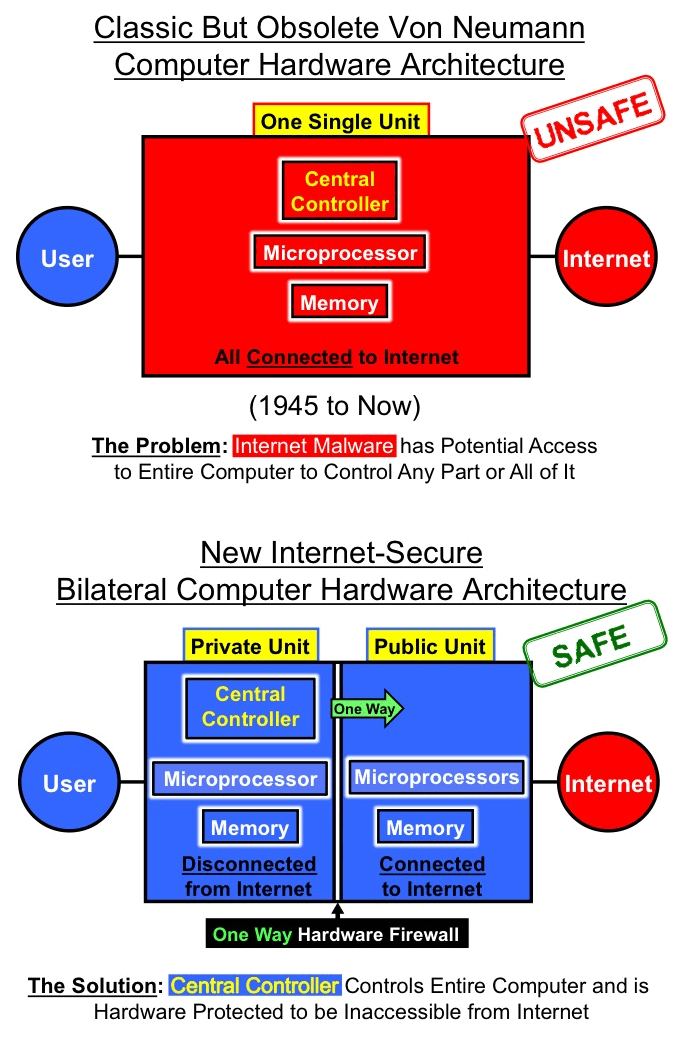
Global's solution to this and other peer-to-peer security problems is a special new hybrid firewall that is uniquely located internally in a personal computer, not in the conventional location between the PC and the network. Also unlike conventional firewalls, which control access by selectively denying access, Global's firewall is also unique in that it completely denies access to a totally protected portion of the PC from any network connection.

The Global internal hybrid firewall thereby partitions the personal computer itself into two sides: a private side that specially protects the PC user's personal and system files; and a public, network side. Although Global's solution can be implemented in software only, it provides the highest possible level of security when hardware-based, particularly at the microchip level.

This is because any software only-based security system, even an excellent one like Java "sandboxes", has the inherent weakness that it might be cracked from an untrustworthy Internet source. Similarly, VMware’s virtual machine technology is a software solution.

CONSORTIUM’S NEW SECURITY SOLUTION IS NOT P2P

The level of security provided by Global's approach goes substantially beyond other security approaches, even the latest like the Trusted Computing Platform Alliance (TCPA), an industry consortium founded in October, 1999 by Microsoft, Compaq, Intel, HP, and IBM (and now with 160 corporate members).

TCPA is based on the old client/server network model, not peer-to-peer computing in its current meaning wherein any "peer" can alternately be either a client or a server, not just one or the other. It does provide a very useful enhancement over the unsafe situation currently existing.

TCPA ONLY DETECTS SECURITY PROBLEMS

TCPA’s Trusted Computing Platform Specification Version 1.0, released January 30, 2001, is just a partial security solution that operates during the boot up process and protects only the PC’s BIOS and operating system files, not the peer PC user’s personal files.

It does not prevent security problems (or cure them), but only identifies that security problems have occurred in the PC. If a virus has altered software, for example, the software change will be detected, but the alteration of system software by the virus is not prevented.

The very limited goal is to protect the PC and network system against compromised PC clients by identifying them. By its incompleteness, TCPA has already encouraged the development of newly released add-on proprietary security systems that create a familiar PC client dependency on network servers.

Such systems are designed to create a "trusted client" in order to protect the network server from the client PC, not the peer PC from the network. This is the wrong orientation.

But the fundamental problem with TCPA is that it only detects problems, rather than preventing them from occurring.

GLOBAL’S SOLUTION PREVENTS SECURITY PROBLEMS

Instead, the goal should be to make each peer in the network independently secure by preventing problems, not by only detecting them. Indeed, every separate computing device from server to appliance that is connected to the Internet or other network should independently have security based on prevention, not just detection.

Global’s PC peer-based security solution makes that independent prevention possible. Moreover, the overall safety of the entire network is best protected by preventing security problems in each individual PC peer in it.

In contrast to other security approaches, Global's solution is a pure peer-based architecture that guarantees that each individual PC user has ultimate control over the security of his or her own PC peer with no possibility of direct intervention by network third parties whether "trusted" or not. Viral alteration of system or personal files is prevented by Global’s architecture rather than just detected.

The security provided by Global’s unique architecture can be further enhanced using other conventional security features like PKI encryption that are implemented on a peer-to-peer basis only, not through a third party server.

INDIVIDUAL PERSONAL FREEDOM IS AT ISSUE

Without dwelling the dark specter raised by 1984 and "Big Brother", there is a very real issue of personal freedom at stake in making this most fundamental security system choice. Without truly effective protection of personal privacy in what is soon to be a ubiquitous Internet, individual personal freedom cannot be safe.

And it should be remembered that the main reason for the decisive triumph of the personal computer over other forms of computing was that it gave control over computing to individual users. Global's approach to PC security provides for that ultimate personal user control to continue even in the totally connected world of Internet peer-to-peer computing.

OTHER BENEFITS OF GLOBAL’S SOLUTION

Global’s internal, total access denial firewall solution provides the best possible protection to personal computer users by absolutely precluding direct access by even the cleverest of malicious hackers from the Internet.

At the same time, Global’s solution provides the best means possible for protecting clients in distributed computing systems from any surveillance or intervention by the PC users providing idle time computing resources.

As it turns out, Global's solution is so basic it offers the clear potential to alleviate dramatically, or even solve, other longstanding security problems, such as those inherent in email like viruses and trojan horses.

A NEW ARCHITECTURE FOR A TRUE INTERNET PC

In fact, Global's solution is so basic, by the fact of its existence it exposes the current personal computer architecture as fundamentally obsolete. The existing PC is based on an old stand-alone, "desktop" model that has been jury-rigged to perform an entirely new role as a an Internet computer. It cannot be made safe or reliable without a fundamental architectural change.

Global's personal computer design, with the security features described above, is that fundamental architectural change. It is built from the ground up to provide the safest and most reliable network computing possible, but without sacrificing the essential capacity for complete independence that is both the distinctive feature of the personal computer and the source of its existing extraordinary popularity.

It is anticipated that within about five years all Internet computing devices, wired and wireless, will incorporate Global's security architecture as a mandatory security and privacy feature.

GLOBAL’S BUSINESS PLAN

Global exited stealth mode roughly coincident with the December 26, 2000 issuance of its first patent, U.S. Patent No. 6,167,428.

Global plans to implement a business plan based on the current Qualcomm model, which is to be a pure intellectual property-based, research-intensive licensor. Global’s extensive intellectual property portfolio covers the key enabling technologies of P2P Internet/Intranet computing and related new standards that will emerge.

Global has recently joined the Peer-to-Peer Working Group initiated by Intel, IBM and others. Global is currently developing licensing arrangements and may make one or more strategic acquisitions during 2001.

[GloNetComp] [Who We Are] [PCT Applications] [US Patents] [In Depth]

Tuesday, February 27, 2001