|
The new network computer utilizes PC's as providers of computing power to the network, not just users of network services.
These connections between network and personal computer are enabled by a new form of computer/network financial structure that is rooted on the fact that economic resources being provided the network by PC owners (or leaser) are similar in value to those being provided by the network provider providing connectivity.
Unlike existing one way functional relationships between network providers such as internet service providers (often currently utilizing telecommunications networks for connectivity) and PC users, wherein the
network provider provides access to a network like the Internet for a fee (much like cable TV services), this new relationship recognizes that the PC user is also providing the network access to the user's PC for
parallel computing use, which has a similar value. The PC thus both provides and uses services on the network, alternatively or potentially even virtually simultaneously, in a multitasking mode.
This new network operates with a structural relationship that is roughly like that which presently exists between an electrical power utility and a small independent power generator connected to a deregulated
utility's electrical power grid, wherein electrical power can flow in either direction between utility and independent generator depending on the operating decisions of both parties and at any particular point in time
each party is in either a debt or credit position relative to the other based on the net direction of that flow for a given period, and is billed accordingly.
In the increasingly deregulated electrical power industry, electrical power (both its creation and transmission) is becoming a commodity bought and sold in a competitive marketplace that crosses traditional borders. With the structural relationship proposed here for the new network, parallel free market structures can develop over time in a new computer power industry dominated by networks of personal computers in all their forms providing shared processing in a grid scaling almost seamlessly from local to national (and international) like an open market electrical power grid.
For this new network and its structural relationships, a network provider or Internet service provider (ISP) is defined in the broadest possible way as any entity (corporation or other business, government,
not-for-profit, cooperative, consortium, committee, association, community, or other organization or individual) that provides personal computer users (very broadly defined below) with initial and continuing connection
hardware and/or software and/or firmware and/or other components and/or services to any network, such as the Internet and WWW or Internet II or Next Generation Internet (NGI) or their present or future equivalents,
coexistors or successors, like the herein proposed MetaInternet,including any of the current or future types of Internet access providers (ISP's) including telecommunication companies, television cable or broadcast
companies, electrical power utilities or other related companies, satellite communications companies, or their present or future equivalents, coexistors or successors.
The connection means used in the networks of the network providers, including between personal computers or equivalents or successors, is preferably very broad bandwidth, including electromagnetic connections such
as optical connection, including wired like fiber optic cable or wireless like optical wireless, for example, but not excluding any other electromagnetic or other means, including television coaxial cable and telephone
twisted pair, as well as associated gateways, bridges, routers, and switches with all associated hardware and/or software and/or firmware and/or other components and their present or future equivalents or
successors. The computers used by the Internet service providers include any current or future computers, including such current examples as mainframes, minicomputers, servers, and personal computers, and
associated their associated hardware and/or software and/or firmware and/or other components, and their present or future equivalents or successors.
Other levels of network control beyond the Internet or other network service provider also exist to control any aspect of the parallel processing network structure and function, any one of which levels may or may
not control and interact directly with the PC user.
For example, at least one level of network control like the World Wide Web Consortium (W3C) or Internet Society (ISOC) or other ad hoc industry consortia establish and ensure compliance with any prescribed parallel processing network standards and/or protocols and/or industry standard agreements for any hardware and/or software and/or firmware and/or other component connected to the network. Under the consensus control of these consortia/societies, other levels of the parallel processing network control can deal with administration and operation of the network. These other levels of the parallel processing network control can potentially be constituted by any network entity, including those defined immediately above for network providers.
The principal defining characteristic of the parallel processing network herein described being communication connections (including hardware and/or software and/or firmware and/or other component) of any form,
including electromagnetic (such as light and radio or microwaves) and electrochemical (and not excluding biochemical or biological), between PC users and their computers, with connection (either directly or indirectly)
to the largest number possible of users and their computers and microprocessors being highly advantageous, such as networks like the Internet (and Internet II and the Next Generation Internet) and WWW and equivalents
and successors, like the MetaInternet.
Multiple levels of such networks will likely coexist with different technical capabilities, like Internet and Internet II, but have interconnection and therefore communicate freely between levels, for such standard network functions as electronic mail, for example.
And a personal computer (PC) user is defined in the broadest possible way as any individual or other entity routinely using a personal computer, which is defined as any computer, such as digital or analog or neural
or quantum, particularly including personal use microprocessor-based personal computers having one or more microprocessors (each including one or more parallel processors) in their general current form, including
hardware with fixed or reconfigurable circuitry (such as field-programmable gate array or FPGA) and/or electro-mechanical components (including micro or nano sized) and/or software and/or firmware and/or any other
component and their present and future equivalents or successors, such as application-specific (or several application) computers, network computers, handheld personal digital assistants, personal communicators such as
telephones and pagers, wearable computers, digital signal processors, neural-based computers (including PC's), entertainment devices such as televisions and associated cable digital set-top control boxes, video tape
recorders, video electronic games, videocams, compact or digital video disk (CD or DVD) player/recorders, radios and cameras, other household electronic devices, business electronic devices such as printers, copiers,
fax machines, footwear, automobile or other transportation equipment devices, robots, toys, and other current or successor devices incorporating one or more microprocessors (or functional or structural equivalents),
especially those owned (or leased directly or indirectly) and used directly by individuals, utilizing one or more microprocessors, made of inorganic compounds such as silicon and/or other inorganic or organic (including
biological, such as DNA) compounds. While not personal computers (due generally to high cost), current and future forms of mainframe computers, minicomputers, workstations, and even supercomputers are also be
included with PCs in a parallel processing network, since they can be used functionally in the same general way in the network as a PC.
Such personal computers as defined above have owners or leasers, which may or may not be the same as the computer users. Continuous connection of computers to the network, such as the Internet, WWW, or equivalents or successors, is preferred, but clearly not required, since connection can also be made at the initiation of a shared processing operation.
Parallel processing is defined as one form of shared processing involving two or more microprocessors used in solving the same computational problem or other task. Massively parallel microprocessor processing
involves large numbers of microprocessors.
In today's technology, massive parallel processing is probably to be considered to be about 64 microprocessors (referred to in this context as nodes) and over 7,000 nodes have been successfully tested in an Intel supercomputer design using PC microprocessors (Pentium Pros). It is anticipated that continued software improvements will make possible effective use of a much larger number of nodes, very possibly limited only by the number of microprocessors available for use on a given network, even an extraordinarily large one like the Internet or its equivalents and/or successors, like the MetaInternet. Shared processing also includes multitasking, which is unrelated processing in parallel.
Broadband wavelength or broad bandwidth network transmission is defined here to mean a transmission speed (usually measured in bits per second) that is at least high enough (or roughly at least equivalent to the
internal clock speed of the microprocessor or microprocessors times the number of microprocessor channels equaling instructions per second or operations per second or calculations per second) so that the processing
input and output of the microprocessor is substantially unrestricted, particularly including at peak processing levels, by the bandwidth of the network connections between microprocessors that are performing some form
of parallel processing, particularly including massive parallel processing. Since this definition is dependent on microprocessor speed, it increases as microprocessor speeds increase.
For microchips with more than one processor, the network connection to the microchip is preferred to have bandwidth broad enough to ensure that all of the microprocessors are unrestricted by a bottleneck at the connection during the microprocessors' peak processing levels.
However, a preferred connection means referenced above is a light wave or optical waveguide connection such as fiber optic cable, which in 1996 already provided multiple gigabit bandwidth on single fiber thread and
is rapidly improving significantly on a continuing basis, so the currently preferred general use of optical waveguide connections such as fiber between PCs virtually assures broad bandwidth for data transmission that is
far greater than microprocessor and associated internal bus speed to provide data to be transmitted.
In addition, new wired optical connections or waveguide in the form of thin, mirrored hollow wires or tubes called omniguides offer even much greater bandwidth than optical fiber and without need of amplification when transmitting over distances, unlike optical fiber. The connection means to provide broad bandwidth transmission is either wired or wireless, with wireless (especially optical) generally preferred for mobile personal computers (or equivalents or successors) and as otherwise indicated below. Wireless connection bandwidth is also increasing rapidly and optical wireless bandwidth is considered to offer essentially the same benefit as fiber optic cable: data transmission speed that exceeds data processing speed.
The financial basis of the shared use between owners/ leasers and providers is whatever terms to which the parties agree, subject to governing laws, regulations, or rules, including payment from either party to the
other based on periodic measurement of net use or provision of processing power, in a manner like an deregulated or open market electrical power grid.
In one embodiment, as shown in Figure 1, in order for this network structure to function effectively, there is a meter device 5 (comprised of hardware and/or software and/or firmware and/or other component) to
measure the flow of computing power between PC 1 user and network 2 provider, which might provide connection to the Internet and/or World Wide Web and/or Internet II and/or any present or future equivalent or successor
3, like the MetaInternet.
In one embodiment, the PC user should be measured by some net rating of the processing power being made available to the network, such as net score on one or more standard tests measuring speed or other performance characteristics of the overall system speed, such as PC Magazine's benchmark test program, ZD Winstone (potentially including hardware and/or software and/or firmware and/or other component testing) or specific individual scores for particularly important components like the microprocessor (such as MIPS or millions of instructions per second) that may be of application-specific importance, and by the elapsed time such resources were used by the network. In the simplest case, for example, such a meter need measure only the time the PC was made available to the network for processing 4, which can be used to compare with time the PC used the network (which is already normally measured by the provider, as discussed below) to arrive at a net cost; potential locations of such a meter include at a network computer such as a server, at the PC, and at some point on the connection between the two. Throughput of data in any standard terms is another potential measure.
In another embodiment, as shown in Figure 2, there also is a meter device 7 (comprised of hardware and/or software and/or firmware and/or other component) that measures the amount of network resources 6 that are
being used by each individual PC 1 user and their associated cost. This includes, for example, time spent doing conventional downloading of data from sites in the network or broadcast from the network 6.
Such metering devices currently exist to support billing by the hour of service or type of service is common in the public industry, by providers such as America Online, Compuserve, and Prodigy. The capability of
such existing devices is enhanced to include a measure of parallel processing resources that are allocated by the Internet Service Provider or equivalent to an individual PC user from other PC users 6, also measuring
simply in time. The net difference in time 4 between the results of meter 5 and meter 7 for a given period provides a reasonable billing basis.
Alternately, as shown in Figure 3, a meter 10 also estimates to the individual PC user prospectively the amount of network resources needed to fulfill a processing request from the PC user to the network (provider
or other level of network control) and associated projected cost, provide a means of approving the estimate by executing the request, and a realtime readout of the cost as it occurs (alternatively, this meter might be
done only to alert 9 the PC user that a given processing request 8 falls outside normal, previously accepted parameters, such as level of cost). To take the example of an unusually deep search request, a priority
or time limit and depth of search should optimally be criteria or limiting parameters that the user can determine or set with the device, or that can be preset, for example, by the network operating system of the ISP or
by the operating system of the PC or other components of the parallel processing system.
Preferably, the network involves no payment between users and providers, with the network system (software, hardware, etc) providing an essentially equivalent usage of computing resources by both users and
providers (since any network computer operated by either entity can potentially be both a user and provider of computing resources (even simultaneously, assuming multitasking), with potentially an override option by a
user (exercised on the basis, for example, of user profile or user's credit line or through relatively instant payment).
Preferably, as shown in Figures 4A-4C, the priority and extent of use of PC and other users can be controlled on a default-to-standard-of-class-usage basis by the network (provider or other) and overridden by the
user decision on a basis prescribed by the specific network provider (or by another level of network control). One example of a default basis is to expend up to a PC's or other user's total credit balance with the
provider described above and the network provider then to provide further prescribed service on an debt basis up to some set limit for the user; different users might have different limits based on resources and/or
credit history.
A specific category of PC user based, for example, on specific microprocessor hardware owned or leased, might have access to a set maximum number of parallel PC's or microprocessors, with smaller or basic users
generally having less access and vice versa.
Specific categories of users might also have different priorities for the execution of their processing by the network other than the simplest case of first come, first served (until complete). A very wide range of specific structural forms between user and provider are possible, both conventional and new, based on unique features of the new network computer system of shared processing resources.
For example, in the simplest case, in an initial system embodiment, as shown in Fig. 4A, a standard PC 1 user request 11 for a use involving parallel processing might be defaulted by system software 13, as shown in
Fig. 4B, to the use of only one other essentially identical PC 12 microprocessor for parallel processing or multitasking, as shown in Figure 4C; larger standard numbers of PC microprocessors, such as about three PC's at the next level, as shown in later Figure 10G (which could also illustrate a PC 1 user exercising an override option to use a level of services above the default standard of one PC microprocessor, presumably at extra cost), for a total of about four, then about 8, about 16, about 32, about 64 and so on, or virtually any number in between, is made available as the network system is upgraded in simple phases over time, as well as the addition of sophisticated override options. As the phase-in process continues, many more PC microprocessors can be made available to the standard PC user (virtually any number), preferably starting at about 128, then about 256, then about 512, then about 1024 and so on over time, as the network and all of its components are gradually upgraded to handle the increasing numbers. System scalability at even the standard user level is essentially unlimited over time.
Preferably, for most standard PC users (including present and future equivalents and successors), connection to the Internet (or present or future equivalents or successors like the MetaInternet) can be at no cost
to PC users, since in exchange for such Internet access the PC users can generally make their PC, when idle, available to the network for shared processing. Preferably, then, competition between Internet Service
Providers (including present and future equivalents and successors) for PC user customers can be over such factors as the convenience and quality of the access service provided and of shared processing provided at no
addition cost to standard PC users, or on such factors as the level of shared processing in terms, for example of number of slave PC's assigned on a standard basis to a master PC. The ISP's can also compete for
parallel processing operations, from inside or outside the ISP Networks, to conduct over their networks.
In addition, as shown in Figures 5A-5B, in another embodiment there is a (hardware and/or software and/or firmware and/or other) controlling device to control access to the user's PC by the network. In its
simplest form, such as a manually activated electromechanical switch, the PC user could set this controller device to make the PC available to the network when not in use by the PC user. Alternatively, the PC
user could set the controller device to make the PC available to the network whenever in an idle state, however momentary, by making use of multitasking hardware and/or software and/or firmware and/or other component
(broadcast or "push" applications from the Internet or other network could still run in the desktop background).
Or, more simply, as shown in Figure 5A, whenever the state that all user applications are closed and the PC 1 is available to the network 14 (perhaps after a time delay set by the user, like that conventionally
used on screensaver software) is detected by a software controller device 12 installed in the PC, the device 12 signals 15 the network computer such as a server 2 that the PC available to the network, which could then
control the PC 1 for parallel processing or multitasking by another PC.
Such shared processing can continue until the device 12 detects the an application being opened 16 in the first PC (or at first use of keyboard, for quicker response, in a multitasking environment), when the device 12 signals 17 the network computer such as a server 2 that the PC is no longer available to the network, as shown in Figure 5B, so the network can then terminate its use of the first PC.
In a preferred embodiment, as shown in Figure 6, there is a (hardware and/or software and/or firmware and/or other component) signaling device 18 for the PC 1 to indicate or signal 15 to the network the user PC's
availability 14 for network use (and whether full use or multitasking only) as well as its specific (hardware/software/firmware/other components) configuration 20 (from a status 19 provided by the PC) in sufficient
detail for the network or network computer such as a server 2 to utilize its capability effectively. In one embodiment, the transponder device is resident in the user PC and broadcast its idle state or other
status (upon change or periodically, for example) or respond to a query signal from a network device.
Also, in another embodiment, as shown in Figure 7, there is a (hardware/software and/or firmware and/or other component) transponder device 21 resident in a part of the network (such as network computer, switch,
router, or another PC, for examples) that receives 22 the PC device status broadcast and/or queries 26 the PC for its status, as shown in Figure 7.
In one embodiment, as shown in Figure 8, the network also has resident in a part of its hardware and/or software (and/or firmware and/or other components) a capacity such as to allow it to most effectively select
and utilize the available user PC's to perform parallel processing initiated by PC users or the network providers or others.
To do so, the network should have the (hardware and/or software and/or firmware and/or other component) capability of locating each PC accurately at the PC's position on the geographic grid lines/connection means 23 so that parallel processing occurs between PC's (PC 1 and PC 12)
as close together as possible, which should not be difficult for PC's at fixed sites with a geographic location, customarily grouped together into cells 24, as shown in Figure 8, but which requires an active system for
any wireless microprocessor to measure its distance from its network relay site, as discussed below in Figure 14.
One of the primary capabilities of the Internet (or Internet II or successor, like the MetaInternet) or WWW network computer is to facilitate searches by the PC user or other user.
As shown in Figure 9, searches are particularly suitable to multiple processing, since, for example, a typical search is to find a specific Internet or WWW site with specific information. Such site searches can be broken up geographically, with a different PC processor 1' allocated by the network communicating through a wired means 99 as shown (or wireless connections) to search each area, the overall area being divided into eight separate parts, as shown, which are preferably about equal, so that the total search would be about 1/8 as long as if one processor did it alone (assuming the PC 1 microprocessor provides control only and not parallel processing, which may be preferable in some case).
As a typical example, a single PC user might need 1,000 minutes of search time to find what is requested, whereas the network computer, using multiple PC processors, might be able to complete the search in 100
minutes using 10 processors, or 10 minutes using 100 processors or 1 minute using 1,000 processors (or even 1 second using 60,000 processors); assuming performance transparency, which should be achievable, at least over
time, even for massive numbers of parallel processors. The parallel processing network's external parallel processing is optimally completely scalable, with virtually no theoretical limit.
The above examples also illustrates a tremendous potential benefit of network parallel processing.
The same amount of network resources, 60,000 processor seconds, was expended in each of the equivalent examples. But by using relatively large multiples of processors, the network can provide the user with relatively immediate response with no difference in cost (or relatively little difference) -- a major benefit. In effect, each PC user linked to the network providing external parallel processing becomes, in effect, a virtual supercomputer! As discussed below, supercomputers can experience a similar spectacular leap in performance by employing a thousand-fold (or more) increase in microprocessors above current levels.
Such power will likely be required for any effective searches in the World Wide Web (WWW).
WWW is currently growing at a rate such that it is doubling every year, so that searching for information within the WWW will become geometrically more difficult in future years, particularly a decade hence, and it is already a very significant difficulty to find WWW sites of relevance to any given search and then to review and analyze the contents of the site.
In addition, many more large databases are being made Web accessible and the use of Extensible Markup Language (XML) will accelerate that trend. Moreover, existing search engine results list information from
a prior general search and merely summarized on the web servers of search engine operators, whereas the applicant's invention allows a further contemporaneous specifically targeted search directed by the PC user
utilizing search engine results only as a starting point for much greater depth and analysis allowed by the shared use of many other PC's in a parallel processing operation.
So the capability to search with massive parallel processing will be required to be effective and can dramatically enhance the capabilities of scientific, technological and medical researchers.
Such enhanced capabilities for searching (and analysis) can also fundamentally alter the relationship of buyers and sellers of any items and/or services.
For the buyer, massive parallel network processing can make it possible to find the best price, worldwide, for any product or the most highly rated product or service (for performance, reliability, etc.) within a category or the best combination of price/performance or the highest rated product for a given price point and so on. The best price for the product can include best price for shipping within specific delivery time parameters acceptable to the buyer.
For the seller, such parallel processing can drastically enhance the search, worldwide, for customers potentially interested in a given product or service, providing very specific targets for advertisement.
Sellers, even producers, can know their customers directly and interact with them directly for feedback on specific products and services to better assess customer satisfaction and survey for new product development.
Similarly, the vastly increased capability provided by the system's shared parallel processing can produce major improvements in complex simulations like modeling worldwide and local weather systems over time, as
well as design and testing of any structure or product, from airliners and skyscrapers to new drugs and to the use of much more sophisticated artificial intelligence (AI) in medical treatment and in sorting through and
organizing the PC users voluminous input of electronic data from "push" technologies. Improvements in games also result, especially in terms of realistic simulation and realtime interactivity.
As is clear from the examples, the Internet or WWW network computer system like the MetaInternet can potentially put into the hands of the PC user an extraordinary new level of computer power vastly greater than
the most powerful supercomputer existing today. The world's total of microchips is already about 350 billion, of which about 15 billion are microprocessors of some kind (most are fairly simple
"appliance" type running wrist watches, televisions, cameras, cars, telephones, etc). Assuming growth at its current rates, in a decade the Internet/Internet II/WWW could easily have a billion individual
PC users, each providing a average total of at least 10 highly sophisticated microprocessors (assuming PC's with at least 4 microprocessors (or more, such as 16 microprocessors or 32, for example) and associated other
handheld, home entertainment, and business devices with microprocessors or digital processing capability, like a digital signal processor or successor devices).
That results in a global computer a decade from now made of at least 10 billion microprocessors, interconnected by broad bandwidth electromagnetic wave means at speeds approaching the speed of light.
In addition, it is preferred the exceptionally numerous special purpose "appliance" microprocessors noted above, especially those that operate now intermittently like personal computers, are designed to
the same basic consensus industry standard as is preferred for parallel microprocessors for PC's (or equivalents or successors) or for PC "systems on a chip" discussed later in Figure 10A-H (so that all PCs
and microprocessors function homogeneously or are homogeneous in the parallel processing Internet, which would be advantageous).
If such PCs and appliance microprocessors are also connected by any broad bandwidth means including fiber optic cable or optical wireless or other wireless, then the number of parallel processors potentially available can increase roughly about 10 times, for a net potential "standard" computing performance of up to 10,000 times current performance within fifteen years, exclusive of Moore's Law routine increases. Web-based ubiquitous computing would become a reality, in terms either of direct connection to the Web or use of common Web standards.
Moreover, in a environment where all current intermittently operating microprocessors followed the same basic design standards as preferred so that all were homogeneous parallel processors, then although the cost per microprocessor increases somewhat, especially initially, the net cost of computing for all users falls drastically due to the general performance increase due to the use of billions of otherwise idle "appliance" microprocessors. Therefore, the overall system cost reduction compels a transformation of virtually all such microprocessors, which are currently specialty devices known as application-specific integrated circuits (ASICs), into general microprocessors (like PC's), with software and firmware providing most of their distinguishing functionality. As noted above, homogeneity of parallel (and multi-tasking) processing design standards for microprocessors and network, including local and Internet, is preferred, but heterogeneity is also a well established parallel processing alternative providing significant benefits compared to non-parallel processing.
To put this in context, a typical supercomputer today utilizing the latest PC microprocessors has less than a hundred.
Using network linkage to all external parallel processing, a peak maximum of perhaps 1 billion microprocessors can be made available for a network supercomputer user, providing it with the power 10,000,000 times greater than is available using current conventional internal parallel processing supercomputers (assuming the same microprocessor technology). Because of it's virtually limitless scalability mentioned above, resources made available by the network to the supercomputer user or PC user can be capable of varying significantly during any computing function, so that peak computing loads can be met with effectively whatever level of resources are necessary.
In summary, regarding monitoring the net provision of power between PC and network, Figures 1-9 show embodiments of a system for a network of computers, including personal computers, comprising: means for network
services including browsing functions, as well as shared computer processing such as parallel processing, to be provided to the personal computers within the network; at least two personal computers; means for at least
one of the personal computers, when idled by a personal user, to be made available temporarily to provide the shared computer processing services to the network; and means for monitoring on a net basis the provision of
the services to each the personal computer or to the personal computer user.
In addition, Figures 1-9 show embodiments including where the system is scalar in that the system imposes no limit to the number of the personal computers, including at least 1024 personal computers; the system is scalar in that the system imposes no limit to the number of personal computers participating in a single shared computer processing operation, including at least 256 personal computers; the network is connected to the Internet and its equivalents and successors, so that the personal computers include at least a million personal computers; the network is connected to the World Wide Web and its successors; the network includes at least one network server that participates in the shared computer processing.; the monitoring means includes a meter device to measure the flow of computing power between the personal computers and the network; the monitoring means includes a means by which the personal user of the personal computer is provided with a prospective estimate of cost for the network to execute an operation requested by the personal user prior to execution of the operation by the network; the system has a control means by which to permit and to deny access to the personal computers by the network for shared computer processing; access to the personal computers by the network is limited to those times when the personal computers are idle; and the personal computers having at least one microprocessor and communicating with the network through a connection means having a speed of data transmission that is at least greater than a peak data processing speed of the microprocessor.
Also, relative to maintaining a standard cost, Figures 1-9 show embodiments of a system for a network of computers, including personal computers, comprising: means for network services including browsing functions,
as well as shared computer processing such as parallel processing, to be provided to the personal computers within the network; at least two personal computers; means for at least one of the personal computers, when
idled by a personal user, to be made available temporarily to provide the shared computer processing services to the network; and means for maintaining a standard cost basis for the provision of the services to each
personal computer or to the personal computer user.
In addition, Figures 1-9 show embodiments including where the system is scalar in that the system imposes no limit to the number of personal computers, including at least 1,024 personal computers; the system is scalar in that the system imposes no limit to the number of the personal computers participating in a single shared computer processing operation, including at least 256 personal computers; the network is connected to the Internet and its equivalents and successors, so that the personal computers include at least a million personal computers; the standard cost is fixed; the fixed standard cost is zero; the means for maintaining a standard cost basis includes the use of making available a standard number of personal computers for shared processing by personal computers;the network is connected to the World Wide Web and its successors; the personal user can override the means for maintaining a standard cost basis so that the personal user can obtain additional network services; the system has a control means by which to permit and to deny access to the personal computers by the network for shared computer processing; the personal computers having at least one microprocessor and communicating with the network through a connection means having a speed of data transmission that is at least greater than a peak data processing speed of the microprocessor.
Browsing functions generally include functions like those standard functions provided by current Internet browsers, such as Microsoft Explorer 3.0 or 4.0 and Netscape Navigator 3.0 or 4.0, including at least access
to searching World Wide Web or Internet sites, exchanging E-Mail worldwide, and worldwide conferencing; an intranet network uses the same browser software, but might not include access to the Internet or WWW.
Shared processing includes parallel processing and multitasking processing involving more than two personal computers, as defined above.
The network system is entirely scalar, with any number of PC microprocessors potentially possible.
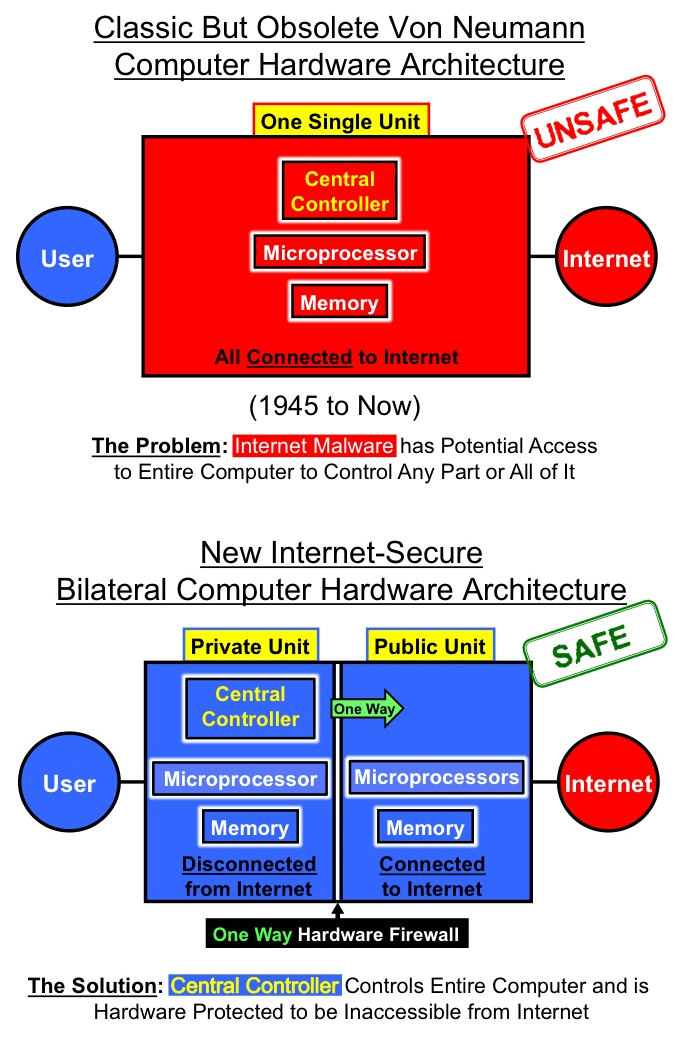
As shown in Figures 10A-10F, to deal with operational and security issues, it may be beneficial for individual users to have one microprocessor or equivalent device that is designated, permanently or temporarily,
to be a master 30 controlling device (comprised of hardware and/or software and/of firmware and/or other component) that remains unaccessible (preferably using a hardware and/or software and/or firmware and/or other
component firewall 50) directly by the network but which controls the functions of the other, slave microprocessors 40 when the network is not utilizing them.
For example, as shown in Figures 10A, a typical PC 1 might have four or five microprocessors (even on a single microprocessor chip), with one master 30 and three or four slaves 40, depending on whether the master
30 is a controller exclusively (through different design of any component part), requiring four slave microprocessors 40 preferably; or the master microprocessor 30 has the same or equivalent microprocessing capability
as a slave 40 and multiprocesses in parallel with the slave microprocessors 40, thereby requiring only three slave microprocessors 40, preferably. The number of PC slave microprocessors 40 can be increased to
virtually any other number, such as at least about eight, about 16, about 32, about 64, about 128, about 256, about 512, about 1024, and so on (these multiples are preferred as conventional in the art, but not
clearly required; the PC master microprocessors 30 can also be increased in number. Also included is the preferred internal firewall 50 between master 30 and slave 40 microprocessors.
As shown in preceding Figures 1-9, the PC 1 in Figure 10A is preferably connected to a network computer 2 and to the Internet or WWW or present or future equivalent or successor 3, like the MetaInternet.
Other typical PC hardware components such as hard drive 61, floppy diskette drive 62, compact disk-read only memory (CD-ROM) 63, digital video disk (DVD) 64, Flash memory 65, random access memory (RAM) 66, video or
other display 67, graphics card 68, and sound card 69, as well as digital signal processor or processors, together with the software and/or firmware stored on or for them, can be located on either side of the preferred
internal firewall 50, but such devices as the display 67, graphics card 68 and sound card 69 and those devices that both read and write and have non-volatile memory (retain data without power and generally have to
written over to erase), such as hard drive 61, Flash memory 65, floppy diskette drive 62, read/write CD-ROM 63 or DVD 64 are preferred to be located on the PC user side of the internal firewall 50, where the master
microprocessor is also located, as shown in Figure 10A, for security reasons primarily; their location can be flexible, with that capability controlled such as by password-authorized access.
Alternately, any or these devices that are duplicative (or for other exceptional needs) like a second hard drive 61' can be located on the network side of the internal firewall 50. RAM 66 or equivalent or
successor memory, which typically is volatile (data is lost when power is interrupted), should generally be located on the network side of the internal firewall 50, however some can be located with the master
microprocessor to facilitate its independent use.
However, read-only memory (ROM) devices including most current CD drives (CD-ROM's) 63' or DVD's (DVD-ROM) drives 64' or can be safely located on the network side of the internal firewall 50, since the data on
those drives cannot be altered by network users; preemptive control of use preferably remains with the PC user.
However, at least a portion of RAM is can be kept on the Master 30 microprocessor side of the internal firewall 50, so that the PC user can use retain the ability to use a core of user PC 1 processing capability
entirely separate from any network processing. If this capability is not desired, then the master 30 microprocessor can be moved to the network side of the internal firewall 50 and replaced with a simpler
controller on the PC 1 user side, like the master remote controller 31 discussed below and shown in Figure 10I.
And the master microprocessor 30 might also control the use of several or all other processors 60 owned or leased by the PC user, such as home entertainment digital signal processors 70, especially if the design
standards of such microprocessors in the future conforms to the requirements of network parallel processing as described above.
In this general approach, the PC master processor uses the slave microprocessors or, if idle (or working on low priority, deferable processing), make them available to the network provider or others to use. Preferably, wireless connections 100, including optical wireless, are expected to be extensively used in home or business network systems, including use of a master remote controller 31 without (or with) microprocessing capability, with preferably broad bandwidth connections such as fiber optic cable connecting directly to at least one component such as a PC 1, shown in a slave configuration, of the home or business personal network system; that preferred connection links the home system to the network 2 such as the Internet 3, as shown in Figure 10I. A business system includes preferably broadband such as fiber optic or optical wireless links to most or all personal computers PC 1 and other devices with microprocessors, such as printers, copiers, scanners, fax machines, telephone and video conferencing equipment; other wired or wireless links can be used also.
A PC 1 user can remotely access his networked PC 1 by using another networked master microprocessor 30 on another PC 1 and using a password or other access control means for entry to his own PC 1 master
microprocessor 30 and files, as is common now in Internet and other access. Alternately, a remote user can simply carry his own digitally stored files and his own master microprocessor or use another networked
master microprocessor temporarily has his own.
In the simplest configuration, as shown in Figure 10B, the PC 1 has a single master microprocessor 30 and a single slave microprocessor 40, preferably separated by a internal firewall 50, with both processors used
in parallel or multitasking processing or with only the slave 40 so used, and preferably connected with broad bandwidth such as optical fiber wire 99 to a network computer 2 and Internet 3 (and successors like the
MetaInternet). Virtually any number of slave microprocessors 40 is possible. The other non-microprocessor components shown in Figure 10A above might also be included in this simple Figure 10B configuration.
Preferably, as shown in Figure 10C, microprocessors 90 are expected to integrate most or all of the other necessary computer components (or their present or future equivalents or successors), like a PC's memory
(RAM 66, graphics 82, sound 83, power management 84, network communications 85, and video processing 86, possibly including modem 87, flash bios 88, digital signal processor or processors 89, and other components or
present or future equivalents or successors) and internal bus, on a single chip 90 (silicon, plastic, or other), known in the industry as "system on a chip".
Such a PC micro chip 90 preferably has the same architecture as that of the PC 1 shown above in Figure 10A: namely, a master control and/or processing unit 93 and one or more slave processing units 94 (for parallel or multitasking processing by either the PC 1 or the Network 2), preferably separated by an internal firewall 50 and preferably connected by broad bandwidth wire 99 such as optical fiber cable to a network computer 3 and the Internet 3 and successors like the MetaInternet. Alternatively, microchip 90 can be an "appliance" system on a chip.
Existing PC components with mechanical components like hard drive 61, floppy or other removable diskette 62, CD-ROM 63 and DVD 64, which are mass storage devices with mechanical features that will likely not become
an integral part of a PC "system of a chip" would preferably, of course, still be capable of connection to a single PC micro chip 90 and control by a single PC master unit 93.
In the simplest multi-processor case, as shown in Figure 10D, the chip 90 has a single master unit 93 and at least one slave unit 94 (with the master having a controlling function only or a processing function
also), preferably separated by an internal firewall 50 and preferably connected by broad bandwidth wire 99 such as fiber optic cable to a network computer 3 and the Internet 3 (and successors like the MetaInternet).
The other non-microprocessor components shown in Figure 10A above might also be included in this simple Figure 10D configuration.
As noted in the second paragraph of the introduction to the background of the invention, in the preferred network invention, any computer can potentially be both a user and provider, alternatively -- a dual mode
operating capability.
Consequently, any PC 1 within the network 2, preferably connected to the Internet 3 (and successors like the MetaInternet), can be temporarily a master PC 30 at one time initiating a parallel or multitasking processing request to the network 2 for execution by at least one slave PC 40, as shown in Figure 10E. At another time the same PC 1 can become a slave PC 40 that executes a parallel or multitasking processing request by another PC 1' that has temporarily assumed the function of master 30, as shown in Figure 10F. The simplest approach to achieving this alternation is for both master and slave versions of the parallel processing software to be loaded in each or every PC 1 that is to share in the parallel processing, so each PC 1 has the necessary software means, together with minor operational modifications, such as adding a switching means by which a signaled request for parallel processing initiated by one PC 1 user using master software is transmitted to at least a second PC 1, triggering its slave software to respond by initiating parallel processing.
As shown in Figures 10G and 10H, which are parallel to Figures 10E and 10F, the number of PC slave processors 40 can be increased to any virtually other number, such as at least about 4; as shown, the processing
system is completely scalar, so that further increases can occur to about eight, about 16, about 32, about 64, about 128, about 256, about 512, about 1024, and so on (these multiples indicated are preferred as
conventional in the art, but not mandatory); the PC master microprocessors 30 can also be increased.
In summary, as noted above relative to Figure 10I, a PC 1 can function as a slave PC 40 and be controlled by a master controller 31, which can be remote and which preferably can have limited or no microprocessing
capability, but can as well have similar or greater capability. As shown in Figures 10J and 10K, such a master controller 31 is located on the PC user side of the internal firewall 50, under the control of the PC
user, while the microprocessors 40 reside on the network side of the internal firewall 50. The master controller 31 preferably receives input from the PC user by local means such as keyboard, microphone, videocam
or future hardware and/or software and/or firmware or other equivalent or successor interface means (as does a master processor 40) that provides input to a PC 1 or microprocessor 30 originating from a user's hand,
voice, eye, nerve or nerves, or other body part; in addition, remote access by telephone, cable, wireless or other connection might also be enabled by a hardware and/or software and/or firmware and/or other means with
suitable security such as password controlled access.
Similarly, as shown in Figure 10L and 10M, relative to a PC "system on a chip" a master controller unit 93' (which could be capable of being accessed by the PC user through a remote controller 31) with only a controlling capability is be located on the PC user side of the internal firewall 50, under the control of the PC user, while the slave processor units 94 would reside on the network side of the internal firewall 50.
Figures 10N and 10O show PC 1 with an internal firewall 50 that is configurable through either hardware and/or software and/or firmware and/or other means; software configuration are easiest and most typical, but
active motherboard hardware configuration is possible and may present some security advantages, including as use of manual or electromechanical or other switches or locks. Figure 10N shows a CD-ROM 63' that has
been placed by a PC user on the network side of an internal firewall 50 from a previous position on the PC user side of an internal firewall 50, which was shown in Figure 10A.
Preferably, the settings of an internal firewall 50 can default to those that safely protect the PC 1 from uncontrolled access by network users, but with capability for the relatively sophisticated PC user to override such default settings and yet with proper safeguards to protect the unsophisticated user from inadvertently doing so; configuration of an internal firewall 50 might also be actively controlled by a network administrator in a local network like that of a business, where a PC user may not be owner or leaser of the PC being used, either by remote access on the network or with a remote controller 31.
Similarly, Figures 10P and 10Q show a PC "system of a chip" 90 with an internal firewall 50 that is configurable through either hardware and/or software and/or firmware and/or other means; software
configuration is easiest and most typical.
Active configuration of the integrated circuits of the PC microchip 90 is also possible and may present some speed and security advantages. Such direct configuration of the circuits of the microchip 90 to establish or change in its internal firewall 50 could be provided by the use of field-programmable gate arrays (or FPGA's) or their future equivalents or successors; microcircuit electromechanical or other switches or locks can also be used potentially. In Figure 10P, for example, slave processing unit 94' has been moved to the PC user side of an internal firewall 50 from a network side position shown in Figure 10C and 10L. Similarly, Figure 10Q shows the same active configuration of chip circuit using FPGA's for the simplest form of multiprocessing microchip 90 with a single slave unit 94', transferring its position to the PC user's side of an internal firewall 50 from a network side shown in Figure 10M and 10D.
In summary, relative to the use of master/slave computers, Figures 10A-10I show embodiments of a system for a network of computers, including personal computers, comprising: at least two personal computers; means
for at least one personal computer, when directed by its personal user, to function temporarily as a master personal computer to initiate and control the execution of a computer processing operation shared with at least
one other personal computer in the network; means for at least one other personal computer, when idled by its personal user, to be made available to function temporarily as at least one slave personal computer to
participate in the execution of a shared computer processing operation controlled by the master personal computer; and means for the personal computers to alternate as directed between functioning as a master and
functioning as a slave in the shared computer processing operations.
In addition, Figures 10A-10H show embodiments including wherein the system is scalar in that the system imposes no limit to the number of personal computers; for example, the system can include at least 256 said personal computers; the system is scalar in that the system imposes no limit to the number of personal computers participating in a single shared computer processing operation, including at least 256 said personal computers, for example; the network is connected to the Internet and its equivalents and successors, so that personal computers include at least a million personal computers, for example; the shared computer processing is parallel processing; the network is connected to the World Wide Web and its successors; a means for network services, including browsing and broadcast functions, as well as shared computer processing such as parallel processing, are provided to said personal computers within said network; the network includes at least one network server that participates in the shared computer processing; the personal computers include a transponder or equivalent or successor means so that a master personal computer can determine the closest available slave personal computers; the closest available slave personal computer is compatible with the master personal computer to execute said shared computer processing operation; the personal computers having at least one microprocessor and communicating with the network through a connection means having a speed of data transmission that is at least greater than a peak data processing speed of the microprocessor; and a local network PC 1 being controlled remotely by a microprocessor controller 31.
The preferred use of the internal firewall 50, as described above in Figures 10A-10I, provides a solution to an important security problem by preferably completely isolating host PC's 1 that are providing slave
microprocessors to the network for parallel or other shared processing functions from any capability to access or retain information about any element about that shared processing.
In addition, of course, the internal firewall 50 provides security for the host PC against intrusion by outside hackers; by reducing the need for encryption and authentication, the use of internal firewalls 50 can provide a relative increase in computing speed and efficiency. In addition to computers such as personal computers, the internal firewall 50 described above could be used in any computing device included in this application's above definition of personal computers, including those with "appliance"-type microprocessors, such as telephones, televisions or cars, as discussed above.
In summary, regarding the use of internal firewalls, Figures 10A-10I show embodiments of a system architecture for computers, including personal computers, to function within a network of computers, comprising: a
computer with at least two microprocessors and having a connection means with a network of computers; the architecture for the computers including an internal firewall means for personal computers to limit access by the
network to only a portion of the hardware, software, firmware, and other components of the personal computers; the internal firewall means will not permit access by the network to at least a one microprocessor having a
means to function as a master microprocessor to initiate and control the execution of a computer processing operation shared with at least one other microprocessor having a means to function as a slave microprocessor;
and the internal firewall means permitting access by the network to the slave microprocessor.
In addition, the system architecture explicitly includes embodiments of, for example, the computer is a personal computer; the personal computer is a microchip; the computer have a control means by which to permit and to deny access to the computer by the network for shared computer processing; the system is scalar in that the system imposes no limit to the number of personal computers, including at least 256 said personal computers, for example; the network is connected to the Internet and its equivalents and successors, so that the personal computers include at least a million personal computers, for example; the system is scalar in that the system imposes no limit to the number of personal computers participating in a single shared computer processing operation, including at least 256 said personal computers, for example; the personal computers having at least one microprocessor and communicating with the network through a connection means having a speed of data transmission that is at least greater than a peak data processing speed of the microprocessor.
In summary, regarding the use of controllers with internal firewalls, Figures 10J-10M show embodiments of a system architecture for computers, including personal computers, to function within a network of
computers, comprising for example: a computer with at least a controller and a microprocessor and having a connection means with a network of computers; the architecture for the computers including an internal firewall
means for personal computers to limit access by the network to only a portion of the hardware, software, firmware, and other components of the personal computers; the internal firewall means will not permit access by
the network to at least a one controller having a means to initiate and control the execution of a computer processing operation shared with at least one microprocessor having a means to function as a slave
microprocessor; and the internal firewall means permitting access by the network to the slave microprocessor. In addition, the system architecture explicitly includes embodiments of, for example, the computer is a
personal computer; the personal computer is a microchip; the computer have a control means by which to permit and to deny access to the computer by the network for shared computer processing; the system is scalar in
that the system imposes no limit to the number of personal computers, including at least 256 said personal computers, for example; the network is connected to the Internet and its equivalents and successors, so that the
personal computers include at least a million personal computers, for example; the system is scalar in that the system imposes no limit to the number of personal computers participating in a single shared computer
processing operation, including at least 256 said personal computers, for example; the personal computers having at least one microprocessor and communicating with the network through a connection means having a speed
of data transmission that is at least greater than a peak data processing speed of the microprocessor; and the controller being capable of remote use.
In summary, regarding the use of internal firewalls that can be actively configured, Figures 10N-10Q show embodiments of a system architecture for computers, including personal computers, to function within a
network of computers, comprising for example: a computer with at least two microprocessors and having a connection means with a network of computers; the architecture for the computers including an internal firewall
means for personal computers to limit access by the network to only a portion of the hardware, software, firmware, and other components of the personal computers; the internal firewall means will not permit access by
the network to at least a one microprocessor having a means to function as a master microprocessor to initiate and control the execution of a computer processing operation shared with at least one other microprocessor
having a means to function as a slave microprocessor; the internal firewall means permitting access by the network to the slave microprocessor; the configuration of the internal firewall being capable of change by a
user or authorized local network administrator; the change in firewall configuration of a microchip PC is made at least in part using field-programmable gate arrays or equivalents or successors.
In addition, the system architecture explicitly includes embodiments of, for example, the computer is a personal computer; the personal computer is a microchip; the computer have a control means by which to permit and to deny access to the computer by the network for shared computer processing; the system is scalar in that the system imposes no limit to the number of personal computers, including at least 256 said personal computers; the network is connected to the Internet and its equivalents and successors, so that the personal computers include at least a million personal computers; the system is scalar in that the system imposes no limit to the number of personal computers participating in a single shared computer processing operation, including at least 256 said personal computers; the personal computers having at least one microprocessor and communicating with the network through a connection means having a speed of data transmission that is preferably at least greater than a peak data processing speed of the microprocessor.
It is would clearly be advantageous for PC 1 or PC 90 microprocessors noted above be designed homogeneously to the same basic consensus industry standard as parallel microprocessors for PC's (or equivalents or
successors) as in Figures 10A-10B or for PC "systems on a chip" discussed in Figures 10C-10D.
Although the cost per microprocessor might rise somewhat initially, the net cost of computing for all users is expected to fall drastically almost instantly due to the significant general performance increase created by the new capability to use of heretofore idle "appliance" microprocessors. The high potential for very substantial benefit to all users should provide a powerful force to reach consensus on important industry hardware, software, and other standards on a continuing basis for such basic parallel network processing designs utilizing the Internet 3 and WWW and successors. It is preferred but not required that such basic industry standards be adopted at the outset of system design and for use of only the least number of shared microprocessors initially. It is preferred that such basic industry homogeneous standards be adopted at the outset and for the least number of shared microprocessors initially, and design improvements incorporating greater complexity and more shared microprocessors be phased in gradually overtime on a step by step basis, so that conversion to a MetaInternet architecture at all component levels be relatively easy and inexpensive (whereas an attempt at sudden, massive conversion is hugely difficult and prohibitively expensive). The scalability of the MetaInternet system architecture (both vertically and horizontally) as described herein makes this sensible approach possible.
By 1998, manufacturing technology improvements allow 20 million transistors to fit on a single chip (with circuits as thin as .25 microns) and, in the next cycle, 50 million transistors using .18 micron circuits.
Preferably, that entire computer on a chip is linked, preferably directly, by fiber optic or wireless optic or other broad bandwidth connection means to the network so that the limiting factor on data throughput in the network system, or any part, is only the speed of the linked microprocessors themselves, not the transmission speed of the network linkage. Such direct fiber or wireless optic linkage and integration of RAM or equivalent on the microchip will obviate the need for an increasingly unwieldy number of microchip connection prongs, which is currently in the three to four hundred range in the Intel Pentium and Pentium Pro series and will reach over a thousand prongs in the 1998 IBM Power3 microprocessor. One or more digital signal processors 89 and one or more all optical switches 92 located on a microprocessor 90 (or 30 or 40), together with numerous channels and/or signal multiplexing (such as wave division) of the fiber optic signal can substitute for a vast multitude of microchip connection prongs.
For computers that are not reduced to a single chip, it is also preferred that the internal system bus or buses of any such PC's have a transmission speed that is at least high enough that the all processing
operations of the PC microprocessor or microprocessors is unrestricted (and other PC components like RAM) and that the microprocessor chip or chips are directly linked by fiber optic or other broad bandwidth connection,
as with the system chip described above, so that the limiting factor on data throughput in the network system, or any part, is only the speed of the linked microprocessors themselves, not the transmission speed of the
linkage.
The individual user PC's can be connected to the Internet (via an Intranet)/Internet II/WWW or successor, like the MetaInternet (or other) network by any electromagnetic means, with the very high transmission speed
provided by the broad bandwidth of optical connections like fiber optic cable being preferred, but hybrid systems using fiber optic cable for trunk lines and coaxial cable to individual users may be more cost effective
initially, but less preferred unless cable can be made (through hardware and/or software and/or firmware and/or other component means) to provide sufficiently broad bandwidth connections to provide unrestricted
throughput by connected microprocessors.
Given the speed and bandwidth of transmission of fiber optic or equivalent or successor connections, conventional network architecture and structures should be acceptable for good system performance, making possible a virtual complete interconnection network between users.
However, the best speed for any parallel processing operation should be obtained, all other things being equal, by utilizing the available microprocessors that are physically the closest together.
Consequently, as shown previously in Figure 8, the network needs have the means (through hardware and/or software and/or firmware and/or other component) to provide on a continually ongoing basis the capability for each PC to know the addresses of the nearest available PC's, perhaps sequentially, from closest to farthest, for the area or cell immediately proximate to that PC and then those cells of adjacent areas.
Network architecture that clusters PC's together should therefore be preferred, but not mandatory for substantial benefit, and can be constructed by wired means. However, as shown in Figure 11, it would
probably be very beneficial to construct local network clusters 101 (or cells) of personal computers 1' by wireless 100 means, especially optical wireless, since physical proximity of any PC 1 to its closest other PC 1'
should be easier to access directly that way, as discussed further below.
Since optical wireless range is about 3 kilometers currently, large clusters communicating with broadband connections are possible. In addition, it is economically preferable for at least several network providers to serve any given geographic area to provide competitive service and prices.
It would be advantageous, then, for those wireless PC connections to be PC resident and capable of communicating by wireless or wired (or mixed) means with all available PC's in the cluster or cell geographic area,
both proximal and potentially out to the practical limits of the wireless transmission.
As shown in Figure 12, wireless PC connections 100 can be made to existing non-PC network components, such as one or more satellites 110, or present or future equivalent or successor components and the wireless
transmissions can be conventional radio waves, such as infrared or microwave, or can utilize any other part of the electromagnetic wave spectrum, particularly optical.
Moreover, as shown in Figure 13, such a wireless or wired approach also make it easily possible in the future to develop network clusters 101 of available PC's 1' with complete interconnectivity; i.e., each
available PC 1 in the cluster 101 is connected (preferably wirelessly 100, especially optical wireless) to every other available PC 1 in the cluster 101, constantly adjusting to individual PC's becoming available or
unavailable. Given the speed of some wired broad bandwidth connections, like fiber optic cable, such clusters 101 with virtual complete interconnectivity is certainly a possible embodiment even for PCs with wired
connections.
As shown in Figure 14A-14D, it would be advantageous for such wireless systems to include a wireless device 120 comprised of hardware and/or software and/or firmware and/or other component, like the PC 1
availability device described above preferably resident in the PC, but also with a network-like capability of measuring the relative distance from each PC 1 in its cluster 101 by that PC's signal transmission by
transponder or its functional equivalent and/or other means to the nearest other PC's 1' in the cluster 101.
As shown in Figure 14A, this distance measurement could be accomplished in a conventional manner between transponder devices 120 connected to each PC in the cluster 101; for example, by measuring in effect the time delay from wireless transmission, optical or other, by the transponder device 120 of an interrogating signal 105 to request initiation of shared processing by a master PC 1 to the reception of a wireless transmission response 106 signaling availability to function as a slave PC from each of the idle PC's 1' in the cluster 101 that has received the interrogation signal 105. The first response signal 106' received by the master PC 1 is from the closest available slave PC 1" (assuming the simplest shared processing case of one slave PC and one master PC), which is selected for the shared processing operation by the requesting master PC 1, since the closer the shared microprocessor, the faster the speed of the wireless connections 100 is between sharing PC's (assuming equivalence of the connection means and other components among each of the PC's 1'). The interrogation signal 105 might specify other selection criteria also, for example, for the closest compatible (initially perhaps defined by a functional requirement of the system to be an identical microprocessor) slave PC 1", with the first response signal 106' being selected as above.
This same transponder approach also can be used between PC's 1" connected by a wired 99 (or mixed wired/wireless) means, despite the fact that connection distances would generally be greater (since not line of
sight, as is wireless), as shown in Figure 14A, since the speed of transmission by the preferred broad bandwidth transmission means such as fiber optic cable is so high as to offset that greater distance. From a
cost basis, this wired approach might be preferable for such PC's already connected by broad bandwidth transmission means, since additional wireless components like hardware and software are not necessary.
In that case, a functionally equivalent transponder device 120 can be operated in wired clusters 101 in generally the same manner as described above for PC's connected in wireless clusters 101. Networks incorporating PC's 1 connected by both wireless and wired (or mixed) means are anticipated, like the home or business network mentioned in Figure 10I, with mobile PC's or other computing devices preferably using wireless connections. Depending on distances between PC's and other factors, a local cluster 101 of a network 2 might connect wirelessly between PC's and with the network 2 through transponding means linked to wired broad bandwidth transmission means, as shown in Figure 14C.
As shown in Figure 14D, the same general transponder device means 120 can also be used in a wired 100 network system 2 employing network servers 98 operated, for example, by an ISP, or in any other network system
architectures (including client/server or peer to peer) or any other topologies (including ring, bus, and star) either well known now in the art or their future equivalents or successors.
The Figure 14 approach to establishing local PC clusters 101 for parallel or other shared processing has major advantage in that it avoids using network computers such as servers (and, if wireless, other network
components including even connection means), so that the entire local system of PC's within a cluster 101 operates independently of network servers, routers, etc.
Moreover, particularly if connected by wireless means, including optical wireless, the size of the cluster 101 could be quite large, being limited generally by PC wireless transmission power, PC wireless reception sensitivity, and local and/or other conditions affecting transmission and reception. Additionally, one cluster 101 could communicate by wireless 100 means with an adjacent, overlapping, or other clusters 101, as shown in Figure 14B, which could thereby include those beyond its own direct transmission range.
Continued ...
|