GloNetComp
Who We Are
PCT Applications
US Patents
In Depth

What’s New
Just Released our third PCT - WO 00.70448


8326 Second Avenue
Vienna, VA 22182-5147
Phone: 703.207.3051
Fax: 703.931.1116

In Depth

During the past year, distributed and "peer-to-peer" computing systems like SETI@home, Napster and Gnutella have suddenly captured the attention of many industry experts, as well as much of the business and popular press. SETI@home is of course now the fastest and least expensive supercomputer on the planet, by far.

And the new "P-to-P" file sharing systems like Napster and Gnutella are considered by many industry notables, including Andy Grove and Marc Andreesson, to hold real potential to change the basic architecture of the Internet, shifting it away from the massive central servers of the World Wide Web to personal computer servers-to-personal computer servers connected by a broadband Internet.  A classic disruptive technology.

Despite this enormous potential, a critical security problem must be solved before safe widespread use is possible. One problem is that P2P systems like Napster and Gnutella open up direct access to the hard drive of each PC peer by unknown, outside peers from anywhere on the Internet. File damage and theft of confidential information by malicious hackers are very real threats.

These obvious threats are widely acknowledged to be unsatisfactorily dealt with by existing peer-to-peer systems, which typically rely on Java sandboxes and encryption.  Moreover, even if significantly improved, such P2P systems can never guarantee that no access hole exists to be exploited by a clever Internet hacker.  Extensive recent experience just in the current year with other Internet software suggests an endless cycle of holes found and then plugged, but often after serious security breaches have occurred.

Even worse, the exponential growth of the existing World Wide Web is being threatened by a rapidly growing awareness by individual PC users of the serious lack of basic security and privacy when connected to the Internety.

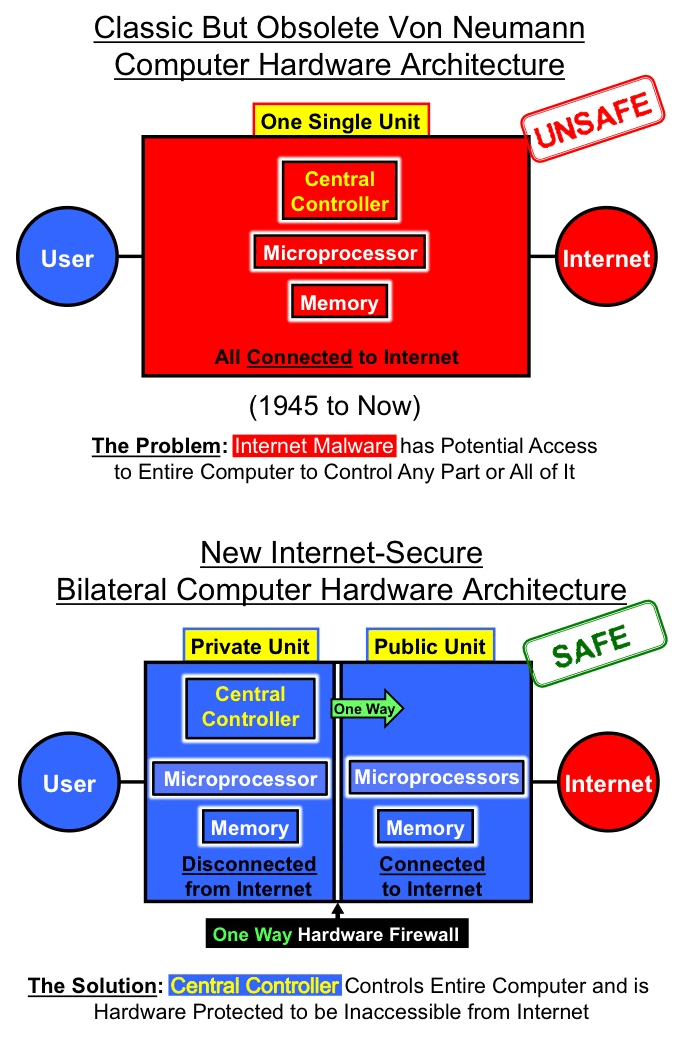
The solution to both serious security problems is the use of Global's newly invented internal firewall. The internal firewall is specifically designed for all personal computers connected to the Internet, particularly those in P2P systems.  The internal firewall invention separates personal computer components into those that are public (and accessible by a network such as the Internet) and those that are private (and inaccessible to outside network users).

In its simplest form, the internal firewall invention has a uniquely simple design which unconditionally denies network access to private components of a personal computer, including at any time that the public components of the PC are being used by the outside network such as by network peers.

In a hardware-based form, the unique internal firewall provides a security solution that completely excludes the possibility of direct intervention by malicious hackers from any network connection. This hardware-based solution includes motherboard modifications and/or microchip level modifications.

The basic physical architecture of a PC (or any PC-like appliance) is fundamentally changed by the new hardware internal firewall. The unitary structure of the existing, inherently insecure PC was designed for stand-alone use. The new bilateral PC structure, with a highly protected private side and a more open public side, is expressly designed for safe use on the Internet.

This hardware-based approach is the only reliable solution to the basic security vulnerability inherent in existing PC's. Every other potential security approach fails to preclude the possibility of network access to all parts of the PC and therefore exposes all parts of the PC to direct attack by malicious Internet hackers.

The above inventions are described in a series of patent applications filed by Global's Founder, Chairman and CEO, Frampton Ellis, with priority dating back to 1996.

Mr. Ellis' patent portfolio describing the above inventions includes about two dozen U.S. applications. A Notice of Allowance have been received for one U.S. application with 83 claims, all including elements of the inventions described above; formal issuance by the USPTO is imminent.  A number of PCT applications have also been filed and several of those have been nationalized to cover all major foreign markets, including Europe, Japan, China, and others.

Both the first and the most recently published PCT patent applications are available at this website at PCT Applications. Relevant portions regarding the above inventions include Figures 10A-10Q and 17A-17D, as well as associated textual specification.
 

[GloNetComp] [Who We Are] [PCT Applications] [US Patents] [In Depth]

Friday, February 16, 2001